Key takeaways
- Four funds on our list focus on autonomy: $CABZ (robotaxis), $DRNZ (drones), $WDRN (physical AI including drones) and $ARKQ (autonomy, robotics and more).
- $ARKQ is by far the largest and oldest, with $1.75B and a launch date of September 30, 2014. The dedicated drone and robotaxi funds are much newer and smaller.
- Drone stocks are closely tied to defense budgets. Robotaxi stocks are tied to regulation and a few large automakers and tech firms.
- Autonomy funds are narrower than classic robotics funds, so expect bigger swings.
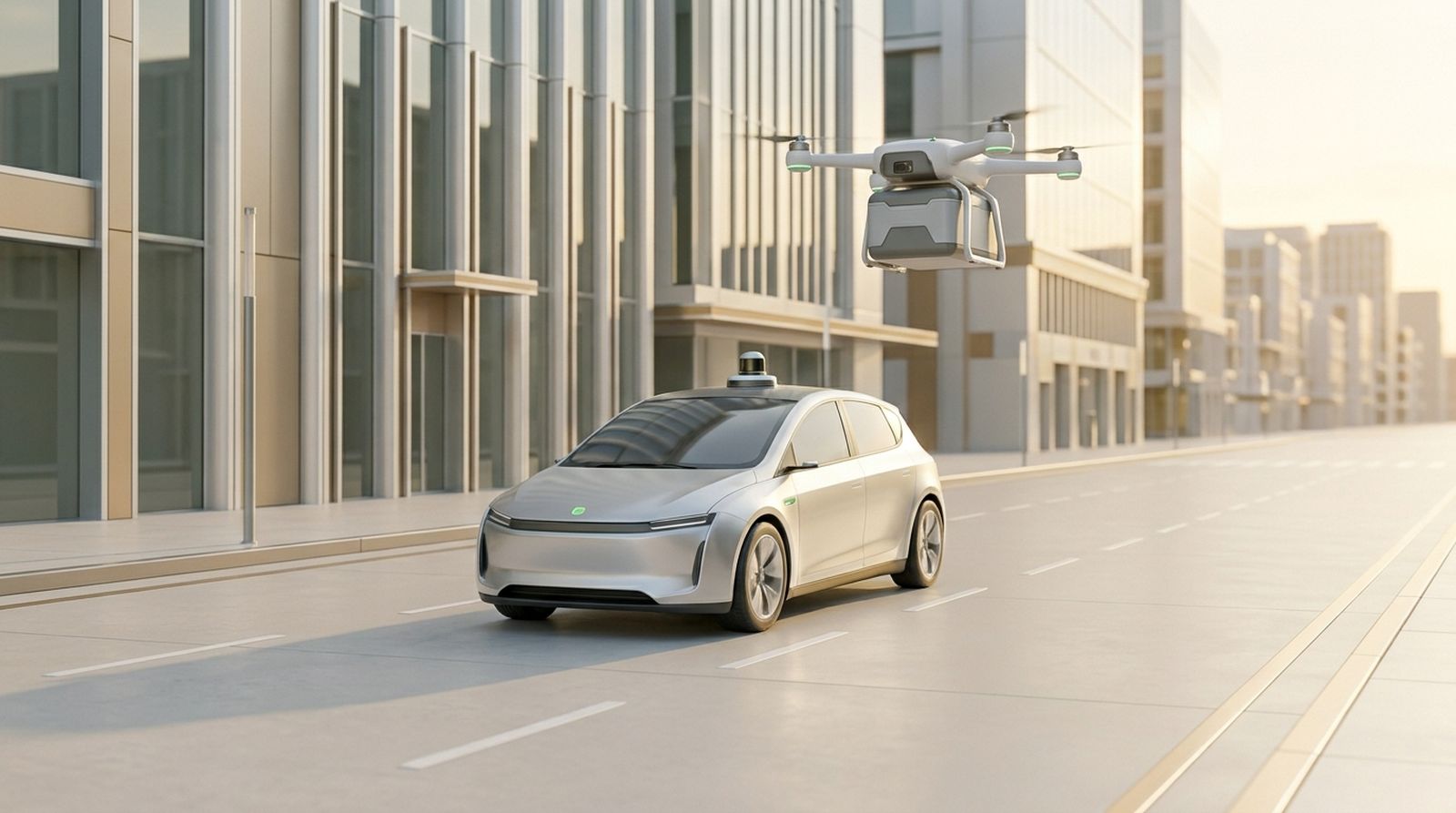
Not every robot works in a factory. Some fly and some drive. Drones and self-driving vehicles are two of the fastest-moving areas of robotics, and they share the same core technology as industrial and humanoid robots: sensors that perceive the world, AI that decides what to do, and motors that act on it. The difference is that these machines move freely through open, unpredictable environments.
A small group of ETFs now targets autonomy directly. This guide covers each one, explains what drives the businesses inside them, and lays out how these funds differ from classic robotics funds like $BOTZ and $ROBO.
The autonomy funds at a glance
| ETF | Provider | Category | AUM | Expense | Yield | Launched |
|---|---|---|---|---|---|---|
| $ARKQ ARK Autonomous Technology & Robotics ETF | ARK Invest | Core robotics | $1.75B | 0.75% | 0.27% | Sep 30, 2014 |
| $CABZ Roundhill Robotaxi, Autonomous Vehicles & Technology ETF | Roundhill | Autonomy & drones | $3.1M | 0.59% | 0.00% | Jan 14, 2026 |
| $DRNZ REX Drone ETF | REX Shares | Autonomy & drones | $78M | 0.65% | 0.00% | Oct 29, 2025 |
| $WDRN WisdomTree Physical AI, Humanoids and Drones Fund | WisdomTree | Physical AI | $18M | 0.45% | 0.00% | May 14, 2026 |
Source: RobotETFs fund data, updated November 7, 2026.
The chart makes the gap clear. $ARKQ has been around since 2014 and holds far more money. The dedicated drone and robotaxi funds launched in 2025 and 2026 and are still building their asset bases.
What makes something "autonomous"
An autonomous machine has to do three things on its own: perceive its surroundings with cameras, radar, lidar and other sensors; decide what to do with onboard computing and AI models; and act through motors, steering and flight controls. Each layer is a business opportunity, which is why autonomy funds hold a mix of vehicle makers, chip companies, sensor makers and software firms.
| Layer | What it does | Types of companies |
|---|---|---|
| Perceive | Sees the world | Camera, radar, lidar and sensor makers |
| Decide | Plans the next move | AI chip designers, autonomy software developers |
| Act | Moves the machine | Vehicle makers, drone manufacturers, motor and control suppliers |
| Operate | Runs the service | Robotaxi operators, delivery and logistics platforms |
Robotaxis: $CABZ
Roundhill's $CABZ targets companies building autonomous vehicles and robotaxi services, from the vehicle platforms to the sensors, chips and software behind them. It launched on January 14, 2026 and holds $3.1M, with a 0.59% expense ratio.
What drives robotaxi stocks: the pace of driverless service launches in new cities, safety records, regulation at the state and federal level, and the economics of running a fleet without drivers. A handful of very large automakers and technology companies dominate the space, so a robotaxi fund's results can hinge on a few names.
Watch for: concentration in a few big holdings, and regulatory news that can move the whole group at once.
Drones: $DRNZ
REX's $DRNZ focuses on companies building drones and unmanned systems for defense, commercial and consumer use. It holds $78M and charges 0.65%.
What drives drone stocks: military demand is the biggest factor. Modern conflicts have shown how important small, cheap unmanned systems have become, and governments have increased spending on them. Commercial uses such as inspection, agriculture, mapping and delivery are growing too, but defense contracts still drive much of the revenue.
Watch for: sensitivity to defense budgets, contract announcements and geopolitical news. A drone ETF can trade more like a defense fund than a technology fund.
Physical AI mix: $WDRN
WisdomTree's $WDRN combines drones with humanoids and other physical AI. It launched on May 14, 2026 with a 0.45% fee and holds $18M. It suits investors who want exposure to several kinds of autonomous machines in one fund rather than a single niche.
The veteran: $ARKQ
ARK's $ARKQ is actively managed and covers autonomous vehicles, robotics, 3D printing, energy storage and space exploration. It launched on September 30, 2014, holds $1.75B and charges 0.75%. ARK is known for concentrated, high-conviction portfolios, so a few large positions can drive results. It is the most established way to get autonomy exposure, but it is broader than a pure drone or robotaxi fund.
How autonomy funds differ from classic robotics funds
| Classic robotics (BOTZ, ROBO) | Autonomy (CABZ, DRNZ) | |
|---|---|---|
| Main customers | Factories, warehouses, hospitals | Consumers, cities, militaries |
| Key drivers | Industrial spending, labor costs, AI chips | Regulation, defense budgets, fleet economics |
| Track record | Many years | Mostly new funds |
| Concentration | Moderate | Often high |
| Typical fund size | Billions | Millions |
The practical result: autonomy funds are narrower bets. They can move sharply on a single regulatory decision or defense budget, while classic robotics funds tend to follow broader industrial and tech trends.
Risks specific to drone and robotaxi ETFs
- Regulation: driverless vehicles and drone flights are heavily regulated. Rule changes can open or close markets quickly.
- Safety events: a single high-profile accident can hit the whole robotaxi group.
- Defense dependence: drone makers can be exposed to budget cuts or contract delays.
- Small fund size: newer autonomy funds can trade with wider spreads and carry closure risk.
- Overlap: large automakers and chip companies also appear in broad tech and AI funds you may already own.
For a full list of risks across the category, see our robotics ETF risk guide.
The bottom line
Autonomy is one of the most exciting slices of robotics and one of the most volatile. $ARKQ offers the longest track record, $CABZ and $DRNZ offer pure exposure to robotaxis and drones, and $WDRN blends autonomy with humanoids. See every fund on the robotics ETF table and filter by the Autonomy and drones category, or compare funds side by side on the compare page. Nothing here is a recommendation to buy or sell.
Sources and methodology
Fund figures (assets, expense ratios, yields, launch dates) come from our RobotETFs data sheet, which we check against issuer materials and refresh daily. Always confirm the latest numbers with the issuer before investing.
Frequently asked questions
Is there a drone ETF?
Yes. DRNZ from REX Shares focuses on drone and unmanned systems companies, and WDRN from WisdomTree mixes drones with humanoids and physical AI.
Is there a robotaxi ETF?
CABZ from Roundhill targets robotaxi and autonomous vehicle companies. ARKQ from ARK also holds autonomy and robotics names as part of a broader strategy.
Are drone ETFs defense funds?
Partly. Many drone makers depend on military contracts, so drone ETFs can behave like defense funds and react to defense budget news.
Do robotaxi ETFs own Tesla?
Funds focused on autonomous driving often hold large automakers and technology companies working on self-driving. Check each fund's current holdings on the issuer's site.
Are autonomy ETFs riskier than robotics ETFs?
They are usually narrower, which can mean bigger swings. Their results depend heavily on a few themes like regulation and defense spending.
RobotETFs.com is published by Dividend Empire LLC for informational and educational purposes only and does not constitute investment, financial, tax or legal advice. Nothing here is a buy or sell signal. Fund data comes from our own data sheet and issuer materials, is refreshed daily and can be delayed, incomplete or incorrect. Always verify against the issuer's website and prospectus, do your own research and consult a licensed financial professional. Past performance does not guarantee future results. Investing involves risk, including possible loss of principal. Leveraged ETFs reset daily and are not suitable for most long-term investors. Price charts are provided by TradingView and may be delayed.