Key takeaways
- $BOTZ is Global X's index fund for robotics and AI, with $2.60B in assets and a 0.68% expense ratio. It launched on September 12, 2016 and holds about 81 stocks.
- It is top heavy: the 10 largest positions were about 57.5% of the fund on November 6, 2026, led by Intuitive Surgical at about 10.9%.
- It is the most "classic robotics" of the big funds. Fanuc, Keyence, ABB, SMC, Daifuku and Cognex make up over a third of the portfolio, and Japan alone was about 32%.
- The long-term record is mixed: about 8.5% a year at NAV over 10 years, but -2.6% a year over 5 years and -13.5% over the last year (Oct 31, 2026).
- BOTZ is a growth fund, not an income fund. It pays twice a year and its last payout was about $0.02 a share.
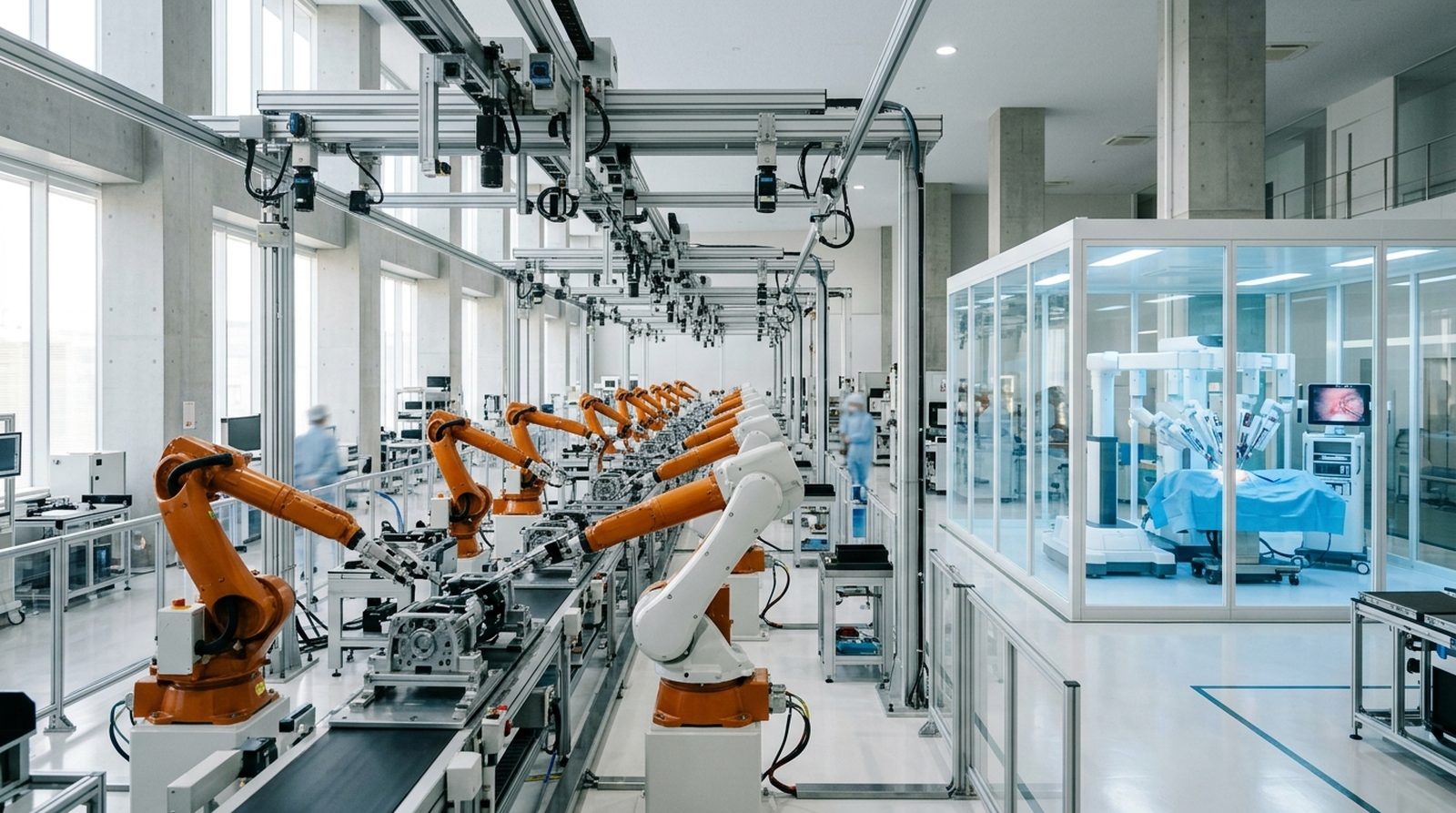
$BOTZ is the biggest dedicated robotics ETF, and the short answer to "what am I actually buying?" is this: an index of about 80 robotics and AI companies that leans hard into the factory. Surgical robots, Japanese robot arm makers, Swiss automation and Nvidia's chips make up most of the money. It holds $2.60B and charges 0.68% a year.
BOTZ is usually the first fund people find when they search for a robotics ETF, so I wanted a proper review of it on its own, not just as half of a comparison. I went through Global X's daily holdings file, the April 2026 summary prospectus, the index methodology and the fund's performance history. Here is what I found.
BOTZ at a glance
A few basics from the prospectus and the fund page that matter more than they look:
- It is passive. BOTZ tracks the Indxx Global Robotics & Artificial Intelligence Thematic Index. Nobody at Global X is picking stocks. The index rules do the picking.
- It is non-diversified. That legal term means the fund can put a large share of its money into a small number of companies, and it does.
- Turnover is low. The prospectus reports portfolio turnover of 12.11% for the most recent fiscal period. That is very low trading, which keeps hidden costs down.
- It is global. Companies from developed markets and China are eligible, which is why so much of the fund sits outside the US.
How the BOTZ index picks stocks
This is the part most people never read, and it explains almost everything about how BOTZ behaves. According to the index methodology summary, the index looks for companies in five areas:
- Industrial robots and automation
- Unmanned vehicles and drones
- Non-industrial robotics, like surgical robots
- Humanoid technology
- AI chips, software or platforms that enable robotics and physical AI
It then holds up to 100 companies ranked by market cap. Most must be "pure plays" that earn more than half their revenue from those areas. A handful of big diversified companies that earn less than half their revenue there are allowed in too, but the index limits how many of those it holds. A company needs at least $300 million in market value and real daily trading volume to get in.
The index is reconstituted and rebalanced twice a year, in March and September, and caps are applied to individual weights at each rebalance. Between rebalances, winners can drift higher. That is exactly what you see today: Intuitive Surgical has grown to almost 11% of the fund.
BOTZ top 10 holdings
Here are the 10 largest positions from Global X's holdings dated November 6, 2026:
| # | Company | What it does | Weight |
|---|---|---|---|
| 1 | Intuitive Surgical ($ISRG) | da Vinci surgical robots | 10.91% |
| 2 | Fanuc (6954 JP) | Industrial robots and factory automation | 8.34% |
| 3 | Keyence (6861 JP) | Sensors, machine vision and automation | 8.06% |
| 4 | ABB ($ABBN SW) | Robotics, electrification and automation | 7.68% |
| 5 | Nvidia ($NVDA) | AI chips and robotics computing | 7.45% |
| 6 | SMC (6273 JP) | Pneumatic components for automation | 4.22% |
| 7 | Daifuku (6383 JP) | Warehouse and material handling systems | 3.14% |
| 8 | Shenzhen Inovance (300124 C2) | Industrial drives, servos and automation | 3.13% |
| 9 | Cognex ($CGNX) | Machine vision systems | 2.32% |
| 10 | Tesla ($TSLA) | EVs, self-driving and Optimus robot | 2.25% |
| Top 10 total | 57.50% |
Unlike $ARKQ, this really is a robotics list. Fanuc and ABB are two of the biggest robot arm makers on the planet. Keyence, SMC and Cognex make the sensors, vision systems and components that robots and automated lines depend on. Daifuku runs automated warehouses and factory logistics. Intuitive Surgical is the leader in robotic surgery.
Nvidia is the AI piece. Its chips and software are becoming the brains for a lot of physical AI, so it fits the index's AI bucket. Tesla is in there for self-driving and its Optimus humanoid program, but at about 2.3% it is a small bet, not a core one. If you want a fund built around AI software and chips instead of machines, my AIQ ETF review covers Global X's bigger sister fund.
Where the money sits: countries and sectors
Global X's portfolio breakdown as of October 31, 2026 shows how international this fund really is:
| Country | Weight |
|---|---|
| United States | 34.81% |
| Japan | 31.67% |
| China | 14.42% |
| Switzerland | 8.81% |
| South Korea | 3.70% |
| Hong Kong | 2.43% |
| Other (Norway, Taiwan, France, Canada) | About 4.2% |
Only about a third of BOTZ is in US companies. Japan is almost as big, because Japan is where so much of the world's factory automation is built. That is a real diversifier if most of your portfolio is in an S&P 500 fund, and it is also a real risk: the yen and Japanese industrial cycles now matter to your returns.
China is the other surprise at about 14%. The index caps Chinese companies at each rebalance, but weights drift in between and data providers classify companies by country in different ways, so do not be surprised if the number moves around.
By sector, Global X lists industrials at 46.21%, information technology at 32.52% and health care at 13.02%. In other words, BOTZ is roughly half an industrial fund and a third a tech fund, with a healthcare kicker from the surgical robots.
What BOTZ costs you
Source: RobotETFs fund data, updated November 26, 2026.
BOTZ charges 0.68% a year. The prospectus shows that is all management fee, with no 12b-1 fee and zero other expenses. In dollars, that is about $68 a year on $10,000. The prospectus example puts the cost at $847 over 10 years on $10,000, assuming a 5% yearly return.
For context, the same $10,000 costs about $95 a year in $ROBO, $75 in $ARKQ and $47 in $IBOT. The average across the 30 robotics funds we track is 0.66%, so BOTZ sits in the middle. Not cheap, not expensive. Here is what fee differences add up to over long holding periods:
Source: RobotETFs fund data, updated November 26, 2026. Hypothetical example, not a projection of any fund's returns.
The low 12% turnover helps here too. Trading costs are not in the expense ratio, so a fund that barely trades keeps more of its return. If cost is your top priority, my cheapest robotics ETFs guide covers every lower-fee option.
How BOTZ has performed
Here are Global X's annualized total returns at NAV, with distributions reinvested, as of October 31, 2026:
| Period | BOTZ (NAV) | Index |
|---|---|---|
| 1 year | -13.53% | -13.33% |
| 3 years | +13.13% a year | +13.53% a year |
| 5 years | -2.62% a year | -2.25% a year |
| 10 years | +8.48% a year | +8.87% a year |
| Since inception (Sep 12, 2016) | +8.46% a year | +8.84% a year |
Two things stand out. First, BOTZ tracks its index closely. The gap each year is roughly the fee, which is what you want from an index fund.
Second, the ride has been rough. Five years of slightly negative returns, a strong three-year stretch, and then a double-digit drop over the last year. Global X lists a beta of 1.72 against the S&P 500 and a standard deviation of 26.70% as of October 31, 2026. In plain English, BOTZ has tended to move a lot more than the overall market, in both directions.
Here's what I actually look at with a fund like this: am I being paid for that volatility? Over 10 years, about 8.5% a year is respectable for a thematic fund, but it has not been a smooth way to earn it. If you buy BOTZ, size it so a 30% drop would not make you sell.
Does BOTZ pay a dividend?
Technically yes, practically not much. BOTZ pays semiannually. The June 2026 distribution was about $0.02 a share, and Global X's schedule shows the next ex-date on December 30, 2026. The trailing yield is about 0.61%, and the 30-day SEC yield was slightly negative at -0.01% as of November 6, 2026.
As someone who reached financial freedom by building dividend income, I want to be blunt: BOTZ is not an income tool. Many of its holdings either pay nothing or pay small dividends, and the fee eats most of what comes in. If you want a portfolio that pays your bills, my sister site TopDividendETFs.com is where I track that side of the market. BOTZ is for growth.
BOTZ vs ROBO, ARKQ and IBOT
BOTZ is not your only option, and each of its main rivals is built differently:
| $BOTZ | $ROBO | $ARKQ | $IBOT | |
|---|---|---|---|---|
| Style | Index, market-cap based with caps | Index, broader and more spread out | Active, ARK's picks | VanEck, newer and smaller |
| Launched | September 12, 2016 | October 22, 2013 | September 30, 2014 | April 5, 2023 |
| Expense ratio | 0.68% | 0.95% | 0.75% | 0.47% |
| Main flavor | Factory robots, surgical robots, Nvidia | Whole robotics supply chain | Autonomy, space, defense, AI | Robotics, at a lower fee |
If you are deciding between the two original robotics funds, I wrote a full BOTZ vs ROBO comparison. If ARK is on your list, my ARKQ ETF review shows how little the two funds overlap, and the live side-by-side is on ARKQ vs BOTZ.
How BOTZ ranks by size
Source: RobotETFs fund data, updated November 26, 2026.
Size has real benefits. Global X lists a 30-day median bid-ask spread of just 0.03%, which means it is cheap to trade in and out of. A big, liquid fund is also less likely to be closed than a tiny new launch, which matters in a category where new funds come and go.
The real risks
Concentration
About 57.5% of the money sits in 10 stocks and nearly 11% in one. When Intuitive Surgical, Fanuc, Keyence, ABB or Nvidia have a bad stretch, BOTZ feels it.
Japan, China and currency risk
With about two thirds of the fund outside the US, your returns depend on foreign markets and exchange rates, not just on the companies. China exposure adds regulatory and geopolitical risk on top. My robotics ETF risks guide goes deeper on this.
Industrial cycles
Factory automation spending rises and falls with manufacturing. When factories cut back, robot orders drop, and the Japanese automation names in BOTZ tend to feel it first.
Valuation
Global X lists a price-to-earnings ratio of 41.4 on 2025 earnings and 29.0 on 2026 earnings for the portfolio. That is well above the broad market, so expectations are already high.
Who BOTZ fits, and who it does not
BOTZ may fit you if you want the established robot makers and automation suppliers in one fund, you like an index with clear rules instead of a manager's picks, and you want international exposure that your US index fund does not give you.
BOTZ probably does not fit you if you want humanoid robots and early-stage startups (look at my humanoid robot ETF guide for $KOID and $HUMN, or my full KOID ETF review), you need income, or you cannot stomach a fund that has gone sideways for five years at a time. Also check your overlap: if you already own a lot of Nvidia through a tech fund, BOTZ adds more.
My takeaway
BOTZ is the closest thing to a "pure" robotics index among the big funds. It owns the companies that actually build robots, robot parts and the vision systems that guide them, plus Nvidia and the leading surgical robot maker. It is liquid, trades tightly and tracks its index well.
The trade-offs are concentration, a heavy tilt to Japan and a volatile record, with a strong decade overall but a weak last five years. I would treat it as a growth satellite next to a core index fund, not a core holding, and I would go in knowing the fee is middle of the pack.
See the live numbers and price history on the BOTZ fund page, or browse every fund in the full robotics ETF table. Holdings, weights, country data and returns in this review are from Global X as of the dates noted and will change. This review is for education only and is not a recommendation to buy or sell any fund.
Sources and methodology
Fund figures (assets, expense ratios, yields, launch dates) come from our RobotETFs data sheet, which we check against issuer materials and refresh daily. Always confirm the latest numbers with the issuer before investing.
Frequently asked questions
What are BOTZ's top holdings?
As of Global X's November 6, 2026 holdings, the top five were Intuitive Surgical (about 10.9%), Fanuc (about 8.3%), Keyence (about 8.1%), ABB (about 7.7%) and Nvidia (about 7.5%). The top 10 made up about 57.5% of the fund. Global X updates holdings daily.
Is BOTZ a good long-term investment?
It depends on your goals. Global X reports an 8.48% annualized return at NAV over 10 years, but -2.62% a year over 5 years and -13.53% over the year to October 31, 2026. It is a volatile thematic fund best used as a small growth position. This is not financial advice.
What is BOTZ's expense ratio?
0.68% a year, all of it management fee, according to the April 2026 summary prospectus. That is about $68 a year on a $10,000 position.
Does BOTZ pay a dividend?
Yes, but it is small. BOTZ pays semiannually. The June 2026 payout was about $0.02 a share, and the next ex-date on Global X's schedule is December 30, 2026. Its yield is well under 1%.
Why does BOTZ own so many Japanese stocks?
Because Japan is home to many of the world's biggest robot and factory automation makers, including Fanuc, Keyence, SMC and Daifuku. Japan was about 32% of the fund at the end of October 2026, second only to the US at about 35%.
RobotETFs.com is published by Dividend Empire LLC for informational and educational purposes only and does not constitute investment, financial, tax or legal advice. Nothing here is a buy or sell signal. Fund data comes from our own data sheet and issuer materials, is refreshed daily and can be delayed, incomplete or incorrect. Always verify against the issuer's website and prospectus, do your own research and consult a licensed financial professional. Past performance does not guarantee future results. Investing involves risk, including possible loss of principal. Leveraged ETFs reset daily and are not suitable for most long-term investors. Price charts are provided by TradingView and may be delayed.